[Research]

From A Toy to Transmedia Story world:
A Case Study on Barbie

From A Toy to Transmedia Story world:
A Case Study on Barbie

From A Toy to Transmedia Story world:
A Case Study on Barbie

[Table of Content]

1. Overview

1. Overview

2. State of the Art

2. State of the Art

3. Objective of AI System

3. Objective of AI System

4. Preference for Personalization

4. Preference for Personalization

5. Multi-Device Continuity

5. Multi-Device Continuity

Conclusion

Conclusion

Content

1. Setting the Scene

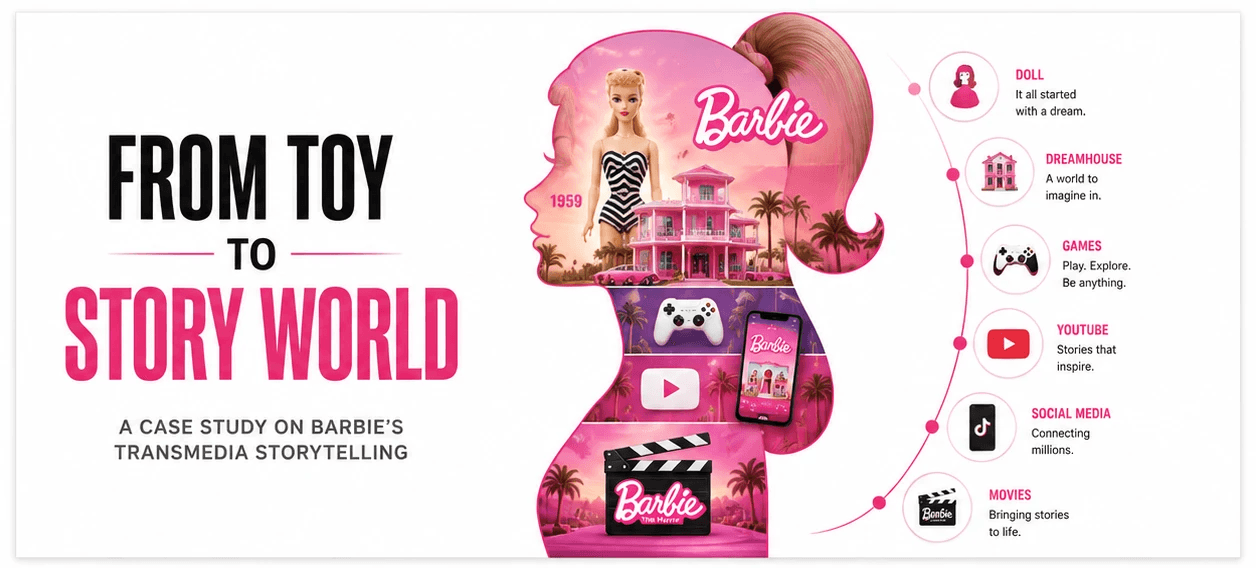
From a simple toy to an expansive transmedia story world, Barbie has invited audiences into a universe of imagination and self-discovery since her debut 65 years ago. What began as a single plastic doll in a black-and-white striped swimsuit has transformed into a multifaceted narrative, brought to life through animated films, digital games, books, and even a blockbuster live-action movie.

This case study explores Barbie’s unique journey as one of the few brands that evolved from a toy into a movie franchise, rather than following the typical path from film to merchandise. Barbie as a transmedia storytelling phenomenon, examining how she has transitioned from a simple toy into a multifaceted brand that engages audiences across various platforms. By critically assessing Barbie’s interactive narrative experiences and their design features, this study will highlight how transmedia storytelling concepts such as interactivity, immersion, and agency have been effectively utilised by the brand. It will demonstrate that Barbie's enduring popularity is not only because of the nostalgia, but also from her ability to adapt and resonate with today’s audience, making them feel inspired and capable through its imaginative storytelling.

Instagram is a leading social media platform owned by Meta that leverages machine learning algorithms for content recommendation at its core. It has over a billion users sharing photos and videos, making it a prime application domain for AI-driven content moderation and recommendation. Content moderation on Instagram uses AI classifiers to detect and remove content violating guidelines, while content recommendation algorithms personalise what each user sees in their feed and the Explore page. These algorithms process vast data in real-time, determining which posts are amplified to wider audiences and which are suppressed. Instagram’s shift in 2016 from a purely chronological feed to an algorithmic feed exemplifies the reliance on machine learning to make the most of your time by showing what you supposedly care about most . In practice, this personalisation has a profound impact on user experience and culture: the platform has become a cultural phenomenon that shapes beauty standards and social values. A growing concern is that Instagram’s AI-powered recommendation system appears to promote immodest or sexually suggestive content amplifying content that show more skin and revealing attire more aggressively than modest content. 

This report is based on a small scale experimental analysis conducted on Instagram. In one example, a creator uploaded two nearly identical video some where the individual wore modest clothing and another with immodest attire. The modest reel reached 3 million views, whereas the immodest one reached 4.5 million, indicating a 1.5x increase in reach. Another creator carried out a similar experiment, two videos were uploaded with the same script, hashtags, and settings. One included a suggestive pose, gaining 2.2 million views, while the more clearly framed and non-suggestive version reached only 558,000 views. These findings highlight growing concerns that Instagram’s AI-powered recommendation system disproportionately amplifies immodest or sexually suggestive content. This report examines that phenomenon in depth, drawing on academic research, industry studies, and the above experiments to critically analyse Instagram’s algorithm, its objectives, the data and patterns it relies on, the actions it takes, and the resulting ethical issues and regulatory implications.

2. Transmedia Storytelling Defined

Transmedia storytelling is becoming an effective way to engage audiences (Jenkins, 2007). Transmedia storytelling, sometimes referred to as transmedia narrative, is the technique of telling a single story across multiple platforms creating a seamless, engaging storytelling experience that fully draws audiences in and making them feel part of the narrative (Scolari, 2009).

Transmedia storytelling allows producers to expand their brand across multiple platforms, to reach a wide variety of audiences and engage them further in the world. For instance, the 2023 Barbie live-action sparked emotional reviews from nostalgic adults, who then remembered about their childhood connections to the doll and the brand. This nostalgia fuelled a resurgence of interest, leading fans not only to purchase Barbie merchandise but also to actively follow the brand’s social media, download games and promote the brand organically creating a renewed cultural phenomenon.

It’s interesting to note that In Barbie’s transmedia universe, each doll comes with its own unique narrative and story, yet all embody the brand's core message of inspiring limitless potential in the audience. This same theme extends across multiple media formats, including comic book series, video games, TV shows, YouTube and social media. Although each medium operates independently narrating a unique, self-contained story that does not necessarily intersect or directly reference each other they’re all unified by Barbie’s overarching brand ethos.

For instance, while the comic books and video games explore unique narratives, they remain rooted in Barbie's core values and themes. Likewise, the TV series and YouTube videos may introduce characters or scenarios exclusive to their platform, but all exist within the same aspirational world of Barbie. To bring this universe full circle, the franchise frequently releases new dolls and toys based on characters from these films or series, followed by an expanded line of merchandise and accessories, reinforcing connections across the Barbie brand.

3. History and Evolution of Barbie Universe  

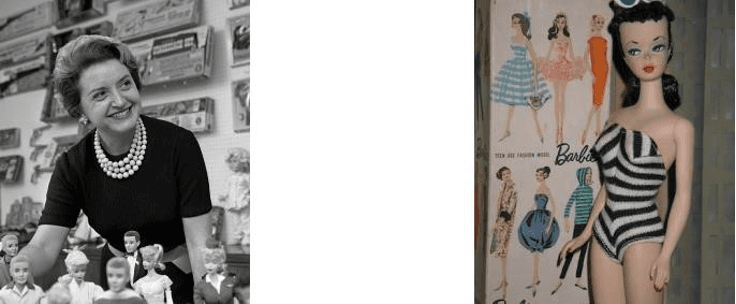
Barbie was introduced by an American toy manufacturing company called Mattel in 1959 as the first adult-themed doll aimed at young girls, challenging traditional toy norms. Ruth Handler, one of the co-founders of Mattel, came up with the idea after observing her daughter, play with paper dolls representing adults, creating stories and role playing the stories with them(Lord, 2004). Ruth wanted to provide a model that could inspire girls to imagine their futures, turning Barbie into a symbol of limitless potential (Rand, 1995).

The algorithm’s notion of relevant and quality recommendation is based largely on popularity and interaction, which might not be normatively desirable content. For example, the system has understood that provocative posts trigger quick responses, so it will preferentially amplify those even when they are not healthy or appropriate. By harshlyoptimizing for engagement, Instagram’s AI may inadvertently promote divisive or objectifying material that keeps eyes glued to the screen. The objective does not explicitly account for context, nor for fairness . Leading to unintended outcomes such as users being exposed to sexual content within minutes of joining, creators pressured to post such content to be successful and users developing distorted perceptions of reality (Segarra, 2024). In short, while maximizing engagement has driven Instagram’s growth the objective, as currently defined, remains questionable from ethical standpoint.

In 1960’s, Mattel began adding narrative layers to Barbie. Barbie’s career and adventures grown from an astronaut, a nurse, CEO to even President of the United States showcasing her character with aspirations beyond playtime. The brand soon introduced Ken as Barbie’s companion and Barbie’s Dreamhouse expanding the narrative further. These narrative elements subtly began expanding her universe, moving her beyond a static toy and setting the stage for future media expansions (Rogers, 1999).

In the 1970s and 1980s, as Barbie gained popularity, Mattel began to build a broader narrative, featuring Barbie in television specials and storybooks with her own family, friends, and relationships. This period marked the first intentional move toward developing Barbie as a character rather than merely a doll. Americans loved barbie so much that an official fan club was formed with more than a million members (FormanBrunell, 2009). Mattel recognised this opportunity and expanded Barbie's merchandise portfolio. In addition to dolls, Mattel produced Barbie-branded school supplies, clothing, and other merchandise, which allowed the audience to experience Barbie’s world in their everyday lives. This period demonstrated a key principle of transmedia storytelling narratives that expanded beyond their original format to other touchpoints.  

The 1990s and early 2000s marked a turning point for Barbie. She starred in animated films like Barbie in the Nutcracker, which set the foundation for fantasy-driven adventures. Additionally, with the rise of personal computers, Mattel released interactive computer games, such as Barbie Fashion Designer, where users could create outfits and customize Barbie’s world. This digital shift offered greater personalization and agency, introducing Barbie to a new, tech-savvy audience (Gerber, 2009).

By the 2010s, Barbie’s online presence expanded with the official Barbie website and YouTube, offering Barbie Vlogs, printable activities, and glimpses into her life (Zeiser, 2015). The vlogs allowed Barbie to speak directly to her audience, fostering an unprecedented level of intimacy and authenticity. The audience could now see Barbie as a friend who shared her life with them, providing a first-person perspective that brought Barbie’s story world closer to the everyday experiences. This form of storytelling made Barbie feel more like a “real” person, reinforcing her role as a character rather than just a toy.

Finally in 2020’s barbies evolution reached new heights as the she adapted cultural and social aspects adopting a more broader range of ethnicities and body types showcasing more inclusive nature. This new-form identity made her more relatable globally (Tamkin, 2023).

In 2023, Barbie made a historic leap into live-action cinema. The film offered a sophisticated and self-aware commentary on Barbie’s impact over the decades, exploring themes of identity, femininity, and societal expectations. The meta-narrative in the film resonated with both younger audiences and nostalgic adults, reintroducing Barbie as a complex cultural symbol (Tamkin, 2023). The film’s success highlighted Barbie’s adaptability and her potential to spark meaningful conversations, solidifying her role as a character whose story could transcend generations and appeal to a broad demographic.

Interactivity, immersion and Agency  

The Barbie universe offers a range of interactive experiences that allows its audience to engage with Barbie’s world, particularly through digital platforms like mobile apps and games. For example, The Barbie’s Dreamhouse Adventures game, where players can control Barbie’s daily life by making choices about activities, designing her surroundings, and interacting with other characters. This interactive framework allows users to step into Barbie’s shoes, transforming them from viewers to active participants in the story. This interactive experience strengthens emotional attachment by providing users a sense of control over the narrative. (Mengan,2016) Additionally, Barbie’s YouTube channel, with vlogs and comment sections, enables fans to feel involved by responding to Barbie’s messages and sharing feedback. Moreover, social media platforms extend this interactivity by letting users share their experiences, create fan content, and even participate in brand-driven challenges, which further connects audience with peers and Barbie’s character.  

Immersive storytelling in Barbie’s transmedia universe creates a sense of being with Barbie, especially within vlogs, animated films, and digital content. Barbie’s YouTube vlogs add to this immersive experience by giving a first-person perspective of Barbie’s life, where she addresses the audience directly, discusses relatable topics, and shares her thoughts, making her feel like a real person and friend. Immersion is further amplified by the visual design and soundscapes in Barbie’s social media and films, which reinforce the fantasy of living in Barbie’s world. This consistency across platforms play a key role in the brands narrative, by keeping her character, themes, and aesthetic uniform across games, movies, and social media, the brand sustains an immersive, cohesive universe that feels like a place fans can enter into and not just a story to observe from outside.

Agency in Barbie’s transmedia universe gives fans the power to influence her world, making them feel like active participants rather than mere spectators. One example is Barbie’s presence on TikTok, where fans participate in “#BarbieChallenge” trends, creating Barbie-inspired looks, dances, or reimagining scenes from Barbie films. This user-generated content allows fans to add their own interpretations to Barbie’s universe, contributing to the story’s ongoing evolution

Additionally, Barbie's interactive stories on platforms like Instagram invite fans to make decisions that shape Barbie’s “day in the life.” Another example would be Instagram stories, fans may be prompted to vote on Barbie’s outfit, travel destination, or even her hobbies through polls. These choices determine the content Barbie posts, allowing fans to feel like co-authors of her digital journey (Alper, 2022). Through these interactive platforms, Barbie’s narrative extends beyond traditional storytelling, positioning her as an evolving character whose story is enriched and diversified by fan input, reflecting the modern transmedia trend where audience agency helps drive the story forward (Wang, 2021).

Conclusion

Barbie stands as a remarkable example of transmedia storytelling, transforming from a toy into an expansive, interactive narrative universe. Through various digital platforms, Barbie’s world invites fans not only to observe her adventures but to actively engage in them. Her universe spans games, social media, and live action movies, which together create an experience full of interactivity, immersion and agency. Audience influence Barbie’s story through TikTok trends, custom doll designs, and interactive polls, creating a participatory culture that extends her reach across generations. These combined elements illustrate the unique storytelling potential of transmedia, positioning Barbie as more than just a toy she is a cultural icon whose narrative evolves with society. This case study demonstrates the value of studying transmedia narratives, as they provide dynamic, co-created storytelling experiences that resonate with modern audiences across multiple media forms. Through this evolving engagement, Barbie remains relevant and inspiring, a testament to the power of story-driven connection across time and technology.

Select this text to see the highlight effect